


A currency transfer can look simple: euros leave one side and roubles arrive on the other. But the sender still needs a payment route, a conversion, clear charges and a view of how much RUB the recipient is expected to get.
The search query how to send money EUR to RUB compresses all of that into a few words. A workable EUR to RUB transfer is really a chain: EUR payment, currency conversion, any applicable fees, then RUB paid out to the recipient. For someone who needs to send EUR to Russia, the final payout is more useful than any single number in the middle.
What an EUR-to-RUB transfer actually means
Sending euros to Russia does not necessarily mean that euros themselves arrive in Russia. With a card-payout service, EUR can be the sending currency while RUB is the payout currency. The provider converts the money before it reaches the recipient.
An international euro transfer that ends in EUR is one product; an EUR money transfer designed to pay out RUB is another. With SendNOW, the sender pays in EUR and the recipient receives RUB on a Russian bank card, including MIR. No SendNOW account, foreign account, IBAN or SWIFT code is needed for the recipient's card payout.
So if you are working out how to transfer EUR to RUB, think of four linked questions: how much EUR you send, which rate is applied, what charges apply and how many roubles are expected to arrive.
The exchange rate is only part of the price
The EUR exchange rate tells you how one currency is valued against another. The ECB publishes euro reference rates every working day, but says they are intended for information rather than transaction pricing. On 20 October 2026, its EUR/USD reference rate was USD 1.1215 per euro.
A transfer provider can therefore show a customer rate that differs from an ECB reference rate, and any conversion fees are often reflected in that rate. The EUR to RUB exchange rate needs to be read alongside the service fee, any payment-method charge and the expected payout. BIS research likewise treats FX pricing and intermediary fees as components of the all-in cost of a transfer. If you are comparing EUR transfer fees or euro transfer costs, compare the expected payout as well.
The phrase euro to Russian ruble sounds like a pure FX question. In a real payment, the euro to ruble conversion only becomes meaningful once the applied rate and charges are known.
What changes at €100, €500 and €2,500?
The basic calculation is simple: (EUR amount − applicable charges) × applicable rate = expected RUB payout.
At €100, a fixed charge, where one applies, takes a noticeable bite out of the payout. At €500, the balance between rate and fees matters more. At €2,500 or above, even a small FX difference can create a much larger difference in roubles received.
Ask how to send money EUR to RUB and the honest answer is that no single route is cheapest at every amount. For a small money transfer in euros, fees can dominate the comparison; for a larger international payment in EUR, the rate deserves more attention.
The World Bank's Remittance Prices Worldwide programme also measures total transfer cost, not just the visible fee. Its latest published global average for sending USD 200 was 6.36%, although that is a global benchmark, not a Russia-specific figure. remittanceprices.worldbank.org
How to send money EUR to RUB now with SendNOW
SendNOW puts the payment, conversion, Russian card payout and tracking into one online flow.
1. Start the transfer
Open SendNOW on the web or in the iOS or Android app and register with email, Google Account or Apple ID. Registration takes about a minute. If required, identity verification may include an ID document and a liveness check.

2. Choose EUR and check the RUB payout
Select EUR as the sending currency, Russia as the destination and enter the amount. Before payment, SendNOW shows the applicable rate, its service fee and the expected amount in RUB. That screen is the key reference for an online EUR transfer because it connects the amount paid with the amount expected on the recipient's side.
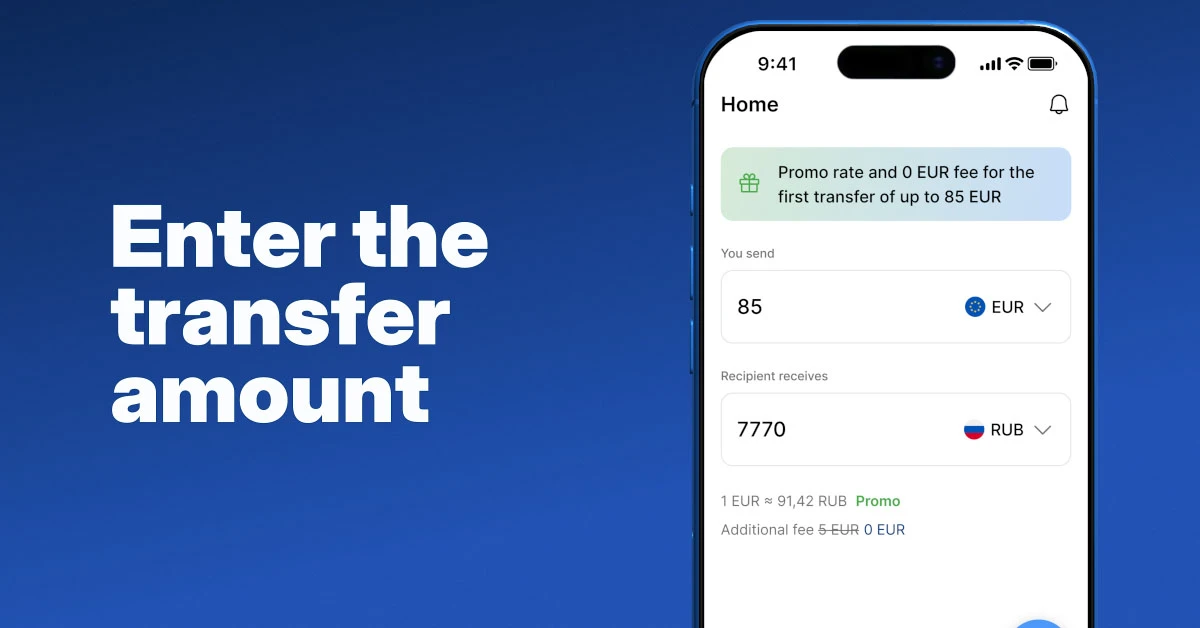
For a new customer, the first transfer up to USD 100 equivalent comes with a promotional rate and a 0% SendNOW service fee.
3. Add the recipient
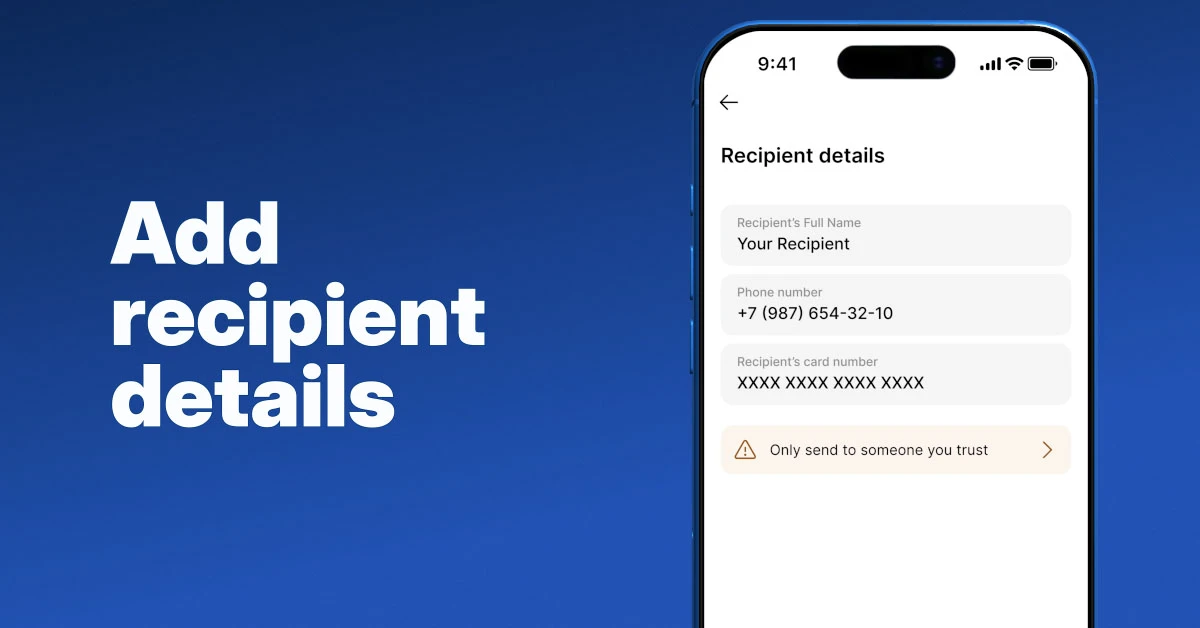
For a card payout, you normally need the recipient's name, phone number and Russian card number. The recipient bank details are lighter than for a wire: no IBAN or SWIFT code is needed. Cards issued by all Russian banks, including MIR, are supported.
4. Pick a payment method
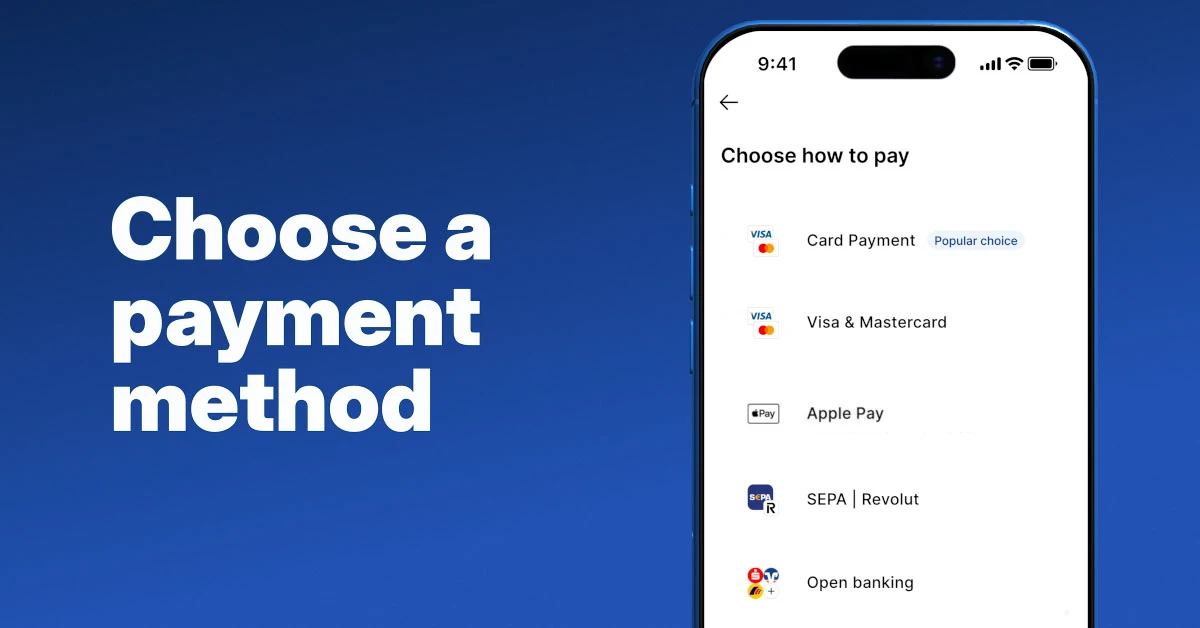
Depending on the transaction, payment options can include Visa, Mastercard, Apple Pay, Google Pay, SEPA and Open Banking. If the selected method carries a separate charge, it is shown before confirmation. That charge is separate from the SendNOW service fee, and the exchange rate is a third element of the price.
5. Confirm and track
Review the amount, rate, service fee and expected RUB payout, then confirm. SendNOW provides transfer tracking. It says 95% of transfers are processed within a minute and average delivery to Russia is around one minute, although checks or the payment method can add time.
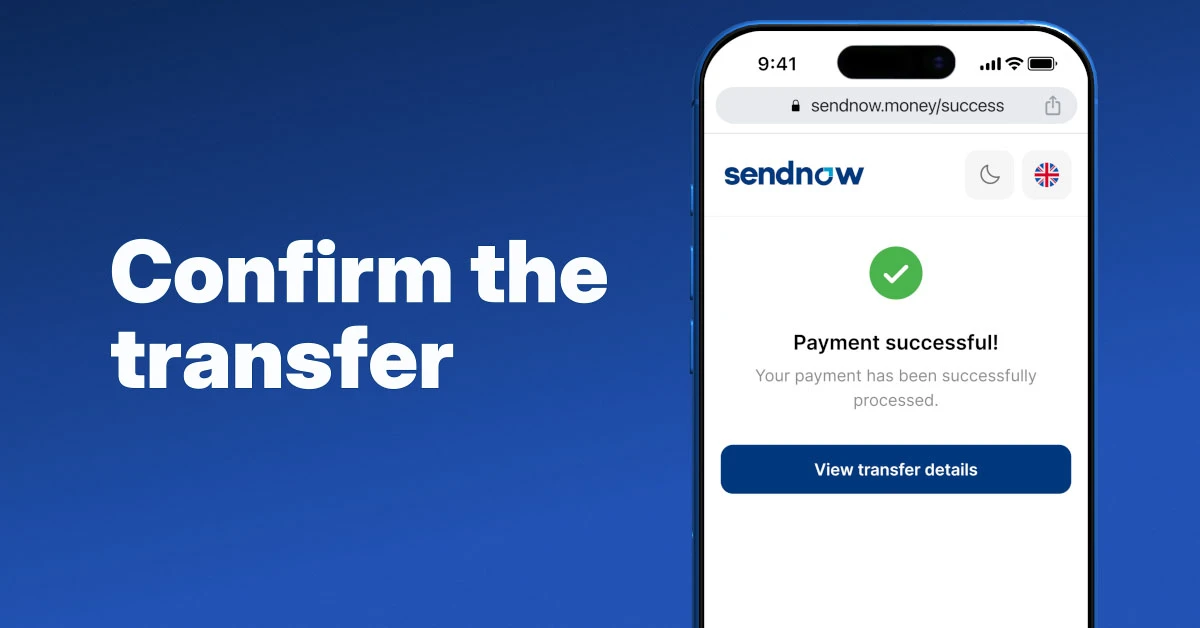
That is the practical answer to how to transfer EUR to RUB without building a correspondent-bank chain or arranging the currency exchange separately.
When the fee is 0%, and when the rate matters more
SendNOW defines its main thresholds in USD equivalent, so the euro amounts move with EUR/USD. Using the ECB reference rate of USD 1.1215 per euro on 20 October 2026, the approximate equivalents are:
first transfer up to USD 100, about €89: promotional rate and 0% SendNOW service fee;
transfers from USD 200, about €178: 0% SendNOW service fee, including repeat transfers;
transfers from USD 2,500, about €2,230: an improved rate is applied automatically;
standard single-transaction limit of USD 50,000, about €44,600.
SendNOW sets these thresholds in USD; the euro figures are conversions at the ECB reference rate of 20 October 2026 and are therefore approximate.
For a small euro transfer to Russia, a fee can have an obvious effect; on a larger cross-border EUR payment, the exchange rate matters more. Compare the same starting EUR amount and expected RUB payout.
This is also why there is no simple “look for 0%” answer to the question how to send money EUR to RUB now. A 0% SendNOW service fee describes one component of the price; a payment-method charge may still apply, and the applied FX rate still matters.
What to check before you confirm
Before you confirm any euro transfer, check the EUR amount, the applied EUR/RUB rate, the SendNOW service fee, any payment-method charge, the expected RUB payout and the delivery estimate. For a secure euro transfer, also make sure you can identify the provider and follow the payment afterwards: SendNOW offers transfer tracking, while an informal intermediary typically does not.
When comparing answers to how to send money EUR to RUB, look at the payout: it brings rate and charges together. When you use an online money transfer service, that is more useful than a headline percentage. The same rule applies whenever you send euros internationally.
Can you wire euros directly to Russia?
A conventional bank route can exist in principle, but it may involve correspondent banks and extra checks. BIS notes that these chains can add cost, delay and opacity. That is why searches for how to wire EUR to RUB often produce a complicated answer: SEPA handles euro payments within its network, but does not by itself solve the final EUR-to-RUB payout onto a Russian card.
If someone types euro to Russia into a search engine, it helps to separate two ideas: paying in EUR and receiving EUR. SendNOW is designed around the first model: EUR goes in, RUB is paid out.
Is it legal to send EUR to RUB?
The currency pair alone cannot answer that. EU guidance says there is no general prohibition on EU citizens paying Russian nationals who hold Russian bank accounts, but other restrictions can still apply.
So is it legal to send EUR to RUB for an ordinary personal transfer? The currencies themselves are not what makes a payment prohibited; the parties, purpose and applicable restrictions are. For unusual, business-related or very large payments, professional advice may be appropriate.
Other routes you may come across
Third-country bank routes add institutions, fees and checks. Crypto and P2P can create a path from EUR to RUB, but the sender must buy a digital asset and arrange the final RUB payout; BIS research notes that conversion, trading and withdrawal costs can materially affect the total. Private intermediaries and Telegram contacts add counterparty risk and offer little or no conventional tracking or recourse.
For a routine euro payment to Russia, those extra moving parts are often the opposite of what the sender wants.
Repeat transfers and larger amounts
For recurring family support, saved recipient details reduce the steps needed to transfer euros online again. For larger payments, SendNOW's standard limit is USD 50,000 equivalent per transaction and the improved rate starts from USD 2,500 equivalent. That makes transfer limits in EUR dependent on EUR/USD rather than on a fixed euro figure. SendNOW
If you need to send funds in EUR for medical costs, education, property or a larger family payment, check the rate and expected payout at the amount you intend to send. A small FX difference becomes more significant as the amount rises.
Whatever the size of the transfer, the test for how to send money EUR to RUB is the same: compare the whole route to the recipient, not one isolated fee.
The payout is the number that ties everything together
A currency transfer is not finished when euros leave the sender; it is finished when the intended roubles reach the recipient.
A useful answer to how to send money EUR to RUB should therefore show the full path: EUR paid, rate applied, charges disclosed and RUB expected on the card. That is also the clearest way to compare routes for how to transfer EUR to RUB in practice.
For anyone still asking how to send money EUR to RUB now, the practical test is simple: can the service accept EUR, show the conversion and charges, pay out RUB to the recipient's Russian card and let you follow the transfer? With SendNOW, those steps sit inside one flow.
A euro to Russian ruble payment may begin as an exchange-rate question. For the person sending money, it ends as a delivery question.
Sources
European Central Bank — Euro foreign exchange reference rates: daily reference rates and the statement that they are published for information purposes rather than transaction pricing.
European Central Bank — What is the role of exchange rates?: explains why reference rates and rates used in actual currency exchange may differ.
Bank for International Settlements — Competing rails for cross-border payments: banks, fintechs, and stablecoins (19 October 2026): all-in costs, FX pricing, intermediary fees and fiat/stablecoin conversion costs.
Bank for International Settlements — Cross-border payment technologies: innovations and challenges (2026): cost, speed, transparency and structural frictions in international payments.
World Bank — Remittance Prices Worldwide: methodology for comparing total remittance cost and latest published global average of 6.36% for sending $200.
European Commission — consolidated Russia sanctions FAQs: confirms there is no general prohibition on EU citizens paying Russian nationals with Russian bank accounts, while other restrictions may still apply.
SendNOW — How to Send Money to Russia in 2026 and current EUR corridor material: fee thresholds, improved-rate threshold, USD 50,000 standard limit, card payout, payment methods and speed claims.


