


Sending money to Russia used to be a fairly ordinary international transaction. A customer could choose between several well-known remittance brands, compare rates and fees, and send the money much as they would to almost any other country.
That is no longer the case.
Western Union suspended its services in Russia in March 2022. TransferGo stopped transfers to the country in the same year, while Wise now lists Russia among the markets it does not support. In October 2025, the EU tightened financial restrictions further, including measures affecting Russian banks, crypto providers and payment systems. KoronaPay Europe has since stopped accepting new transfers and is withdrawing its authorisation.
So the question of how to send money to Russia in 2026 is no longer simply about finding the cheapest provider. It is about finding a route that still works from beginning to end — and knowing who is responsible for the payment if something goes wrong.
For private customers, there are still several realistic options: selected bank transfers, cryptocurrency and P2P transactions, private intermediaries, and specialist online services such as SendNOW.
The four main ways to transfer money to Russia
For anyone researching how to transfer money to Russia, it helps to start with the basic trade-offs.
| Method | Typical timing | Convenience | Main drawback |
|---|---|---|---|
| Bank transfer | Usually several working days | Moderate | Only certain banking routes remain open |
| Crypto / P2P | Minutes to days | More complex | P2P, conversion and compliance risks |
| Private intermediary | Varies | Can look simple | Limited transparency and protection |
| SendNOW | Around one minute on average for Russia transfers | High | No drawbacks |
The important distinction is between a payment method that appears to be available and a route that can actually deliver the money. A bank may allow you to start an overseas payment, for example, but that does not mean every correspondent bank — or the receiving Russian bank — will process it.
Why mainstream money transfer providers left Russia
The market contracted quickly after 2022.
Western Union suspended transfers to and from Russia across all channels from 24 March 2022. TransferGo halted transfers to Russia in the same year. Wise currently states that money cannot be sent to or received from Russia through its service.
The restrictions continued to evolve. The EU’s 19th sanctions package, adopted in October 2025, added transaction bans affecting further Russian and third-country banks and prohibited EU operators from engaging with Russia’s MIR card system and Faster Payments System.
KoronaPay Europe illustrates how quickly the landscape can still change. Its European entity now says that it is voluntarily withdrawing its authorisation, no longer provides regulated services and does not accept new transfers.
That is why the question of how to send money to Russia now looks very different from the one consumers were asking a few years ago.
Bank transfers still exist — but only on selected routes
A SWIFT transfer is often described as though money travels directly from one bank to another. In reality, international banking can involve one or more correspondent institutions between the sender and recipient.
Each institution in that chain must be willing and legally able to process the payment.
A bank transfer to Russia may therefore be possible for one receiving bank and currency, but unavailable for another. Sanctions are only part of the picture: banks also apply their own internal risk and compliance policies.
If you need to know how to wire money to Russia, check the complete route before sending anything. Confirm that the recipient’s bank accepts the currency, that the sending bank is prepared to process the transaction and, where possible, whether correspondent institutions will be involved.
Banking can still make sense for a large, fully documented transfer. It is considerably less convenient for regular family support, where a payment can be held for review for several days can defeat the purpose of the transfer.
Crypto and P2P solve one problem and create several others
Cryptocurrency removes the traditional bank-to-bank link. A typical route is to buy USDT or another cryptoasset, send it to a wallet, and then exchange it for roubles.
The blockchain transfer itself may be fast. The end-to-end process is not necessarily simple.
There may be an exchange fee, a blockchain fee, a spread when converting back into fiat currency and, in a P2P transaction, an unknown counterparty at the other end. Sending crypto over the wrong network can also result in an irreversible loss.
For an experienced crypto user, this can still be a workable route for cross-border transactions. For someone whose question is simply how can I send money to Russia, it may involve far more financial and technical decisions than expected.
Telegram-based exchanges and private managers introduce a different kind of risk. You may not know which company has received the money, where the roubles being paid to your recipient originated, or what formal complaints process exists if the transfer fails.
SendNOW keeps the transfer inside one service
SendNOW is a specialist international money transfer service built around destinations that have become difficult to reach through mainstream providers.
According to its App Store listing, SendNOW supports more than 190 destinations, over 20 sending currencies and more than 70 receiving currencies. It also states that 95% of transfers are processed within a minute.
For Russia, the crucial difference is how the recipient gets paid. SendNOW supports payouts to cards issued by Russian banks, including MIR cards. The recipient does not need an overseas account, an IBAN or a conventional SWIFT payment.
For anyone wondering how to send money to someone in Russia, this makes the process much more straightforward.. The sender creates the transfer online, enters the recipient’s details, chooses an available payment method and follows the transaction from the same account.
The amount the recipient will receive in roubles is calculated before payment, so the expected payout is visible in advance.
How a SendNOW transfer works
The process is closer to an ordinary online money transfer than to arranging an international banking chain.
- Create your SendNOW account. Sign up on the website or in the iOS or Android app. Registration is available by email, Google Account or Apple ID.

- Choose the sending currency and enter the amount. Select your currency, choose Russia as the destination and enter how much you want to send. SendNOW calculates the amount the recipient will receive in RUB. New customers get an improved promotional exchange rate and 0% SendNOW service fee on their first transfer of up to USD 100 or the equivalent.
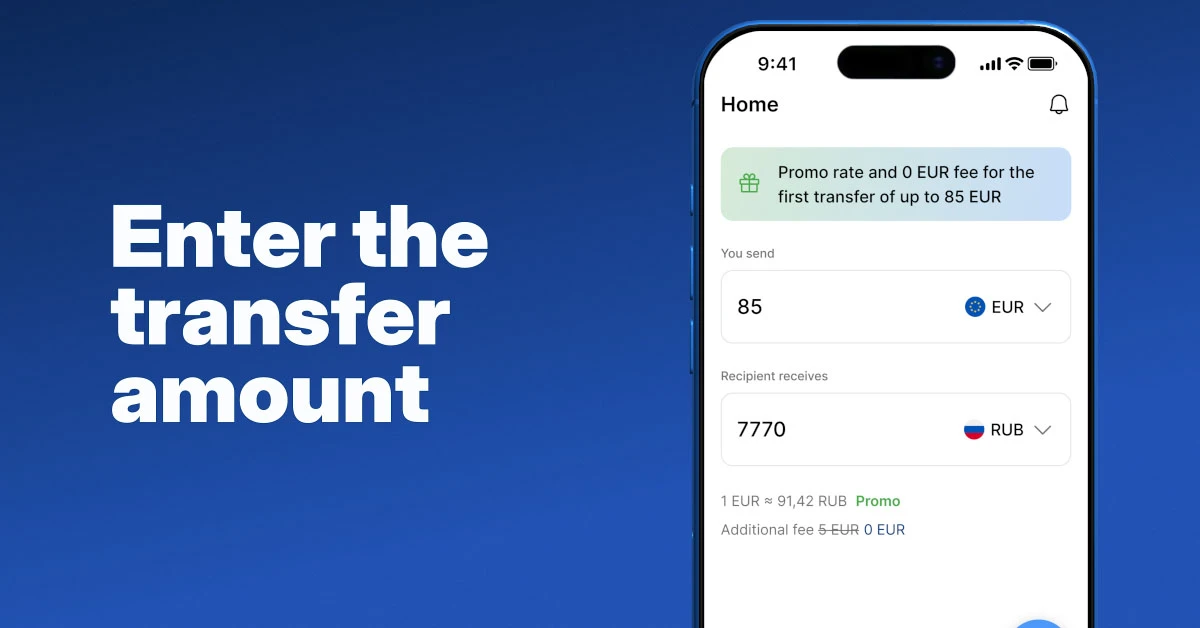
- Add the recipient. For a card payout, the usual information is the recipient’s name, phone number and Russian card number. Once a recipient has been used, their details can be saved for future transfers.

- Choose a payment method. Depending on the country, transaction and payment partner, available options may include Visa, Mastercard, Apple Pay, Google Pay, bank transfer, SEPA or Open Banking.

- Confirm and track the transfer. Complete the payment and follow its progress from your SendNOW account.
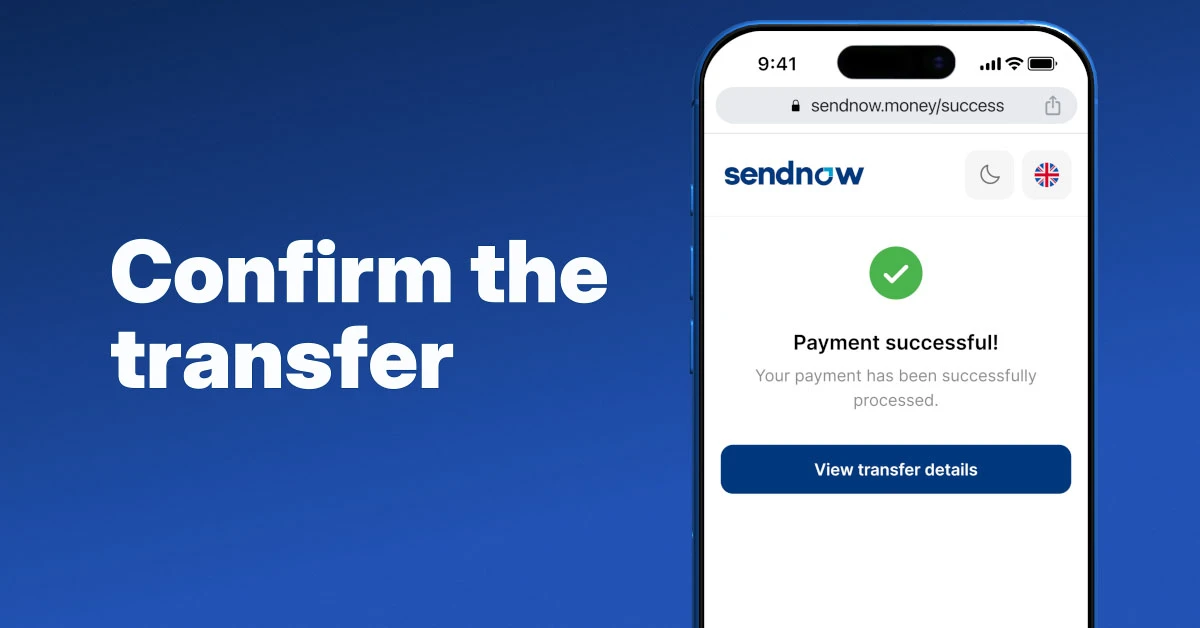
For someone trying to understand how to transfer money to Russia, this is the central advantage: there is no need to piece together a transfer using a bank, an exchange, a crypto wallet and a P2P counterparty.
Fees, exchange rates and larger transfers
International transfers should not be judged on the headline fee alone.
The World Bank’s Remittance Prices Worldwide programme measures the total cost of sending relatively small remittances. Its latest published global average is 6.36% of the amount sent — a reminder that transfer fees are only one part of the cost of sending money abroad.
With SendNOW, the first transfer of up to USD 100 or the equivalent comes with a promotional rate and 0% SendNOW service fee. Transfers of USD 200 or more, or the equivalent, also carry a 0% SendNOW fee, including repeat transfers.
For transfers of USD 2,500 or more, SendNOW automatically applies an improved exchange rate. The standard limit for a single transaction is USD 50,000 or the equivalent.
If you are trying to work out how to send money to Russia, compare each option using the same starting amount and look at what the recipient will actually receive. A nominally fee-free route can still be less attractive if the exchange rate is poorer or other charges are higher.
What countries can still send money to Russia?
A surprisingly common search query is what countries can send money to Russia in 2026.
There is no universal answer that applies to every bank and every provider. The availability of overseas payments depends on the sender’s country, currency, payment method and the service being used.
SendNOW’s App Store listing specifically mentions Germany, the UK, France, the US, Italy, Norway and Poland among its supported sending markets, alongside many other countries. The service supports more than 20 sending currencies.
So when people search for what countries can send money to Russia, the practical question is whether their country and preferred payment method are supported for that particular transfer.
Is it legal to send money to Russia?
There is no single international rule governing every private remittance. Sanctions differ between jurisdictions and typically apply to particular banks, companies, individuals, financial systems or categories of transaction.
A private payment may therefore be lawful while a particular banking route is not available.
One question naturally follows: is it legal to send money to Russia? The answer depends on the sender’s jurisdiction, the recipient and the financial institutions involved. For an unusually large, business-related or otherwise complex transaction, specialist legal or compliance advice may be sensible.
How long does it take to transfer money to Russia?
A conventional bank payment may take several working days and can take longer if it is referred for additional checks. Crypto can move quickly between wallets, but buying the asset and converting it back into roubles adds extra stages.
SendNOW says that 95% of transfers are processed within a minute. The average delivery time for transfers to Russia is around one minute, although verification or the chosen payment method can occasionally make a transaction take longer.
For urgent support to a family member, the useful measure is not how quickly one technical step happens, but how quickly the recipient can actually use the money.
Security is about what happens when a transfer does not go to plan
A transfer route should not be judged solely by whether it worked once.
For secure money transfers, look for a clear transaction record, transfer tracking, customer support and a provider you can identify and verify. Check the recipient details before paying and be prepared to document the source of funds for larger transactions.
This is where the weaknesses of informal P2P and private intermediaries become apparent. A fast exchange arranged in a messaging app may appear convenient until the payment is delayed and nobody has formal responsibility for investigating it.
SendNOW keeps the entire transfer within a single service, with status updates available from the user’s account. For anyone wondering how to send money to Russia now, that visibility is part of the service, not an afterthought.
Match the payment method to the reason for sending
Different transfers require different things.
For regular support to parents or relatives, convenience matters: saved recipient details, a clear transaction history and the ability to repeat the payment without starting from scratch.
For an urgent transfer, fewer intermediate steps are usually more valuable than a marginal difference in price.
For larger financial transfers, transaction limits and source-of-funds checks matter more. SendNOW’s standard limit of up to USD 50,000 per transaction, together with the improved rate from USD 2,500, makes it suitable for significantly larger payments as well as routine remittances.
For anyone comparing money transfer options, a useful question is how much of the process they will have to manage themselves. A SWIFT chain, crypto exchange and P2P counterparty may all be workable, but each adds another moving part.
Before you send: five things worth checking
Before making an international remittance, confirm the recipient’s details, the amount they are expected to receive, the exchange rate, the relevant charges and the expected delivery time.
For a bank payment, check the recipient’s bank account details and make sure the complete correspondent route is available. For a card payout, double-check the card number. For a larger transaction, prepare proof of the source of funds before it is requested.
If the question is how to send money to Russia now, also consider the less obvious part: what happens if the payment is delayed? Established money transfer providers can offer an identifiable transaction, status information and support. An unknown private counterparty may offer none of those things.
Conclusion
The market for remittance services to Russia has changed radically since 2022. Several major consumer brands have disappeared from the payment corridor, while international banking services have become increasingly fragmented.
Bank transfers can still work on selected routes. Crypto offers flexibility, but brings additional technical and P2P risks. Informal intermediaries may provide a route, but often with less transparency.
For anyone trying to work out how to transfer money to Russia, SendNOW preserves something that has become unusually scarce in this payment corridor: a conventional consumer experience. The sender creates the transfer online, sees the amount the recipient will receive, sends the money to the recipient’s Russian bank card and can follow the transaction in the same service.
If the question is how to send money to Russia, the simplest answer in 2026 is usually to choose a route designed specifically for the job rather than building one yourself from several separate international payment solutions.
And for people asking how to send money to someone in Russia on a regular basis — to support parents, children or other family members — repeatability matters just as much as getting the first payment through.
Sources
- World Bank — Remittance Prices Worldwide. Global data on the cost of international remittances; the latest published global average is 6.36%. World Bank — Remittance Prices Worldwide
- Council of the European Union — 19th package of sanctions against Russia. Official information on the October 2025 financial restrictions affecting additional banks, crypto providers, MIR and SBP. Council of the EU — 19th sanctions package
- Western Union — Sending money to and from Russia and Belarus. Confirmation that the company suspended its Russian operations from 24 March 2022. Western Union — Russia and Belarus
- TransferGo. Company information relating to the suspension of transfers to Russia in 2022. TransferGo
- Wise Help Centre. Russia is currently listed among the countries where Wise does not support sending or receiving money. Wise — Where can I use Wise?
- KoronaPay Europe. Official notice that the European entity is withdrawing its authorisation and no longer accepts new transfers. KoronaPay Europe
- Apple App Store — SendNOW. Product information covering 190+ destinations, supported sending and receiving currencies, transfer speed and sending markets. SendNOW — App Store


