


Germany has a large post-Soviet community. Germany’s Federal Agency for Civic Education has previously estimated the number of people with a post-Soviet migration background at around three million, although the estimate is based on older census data and should not be treated as a current count of Russian speakers. bpb
For many families, the link with Russia is practical: supporting parents, paying bills or sending a larger one-off amount. But for anyone researching how to send money from Germany to Russia in 2026, the problem is no longer simply choosing between familiar remittance apps.
Russia is outside SEPA, EU sanctions cover much of its banking sector, and German banks apply their own compliance controls. This guide looks at the routes that still work and how to send money to Russia now without an informal intermediary.
Why Germany-to-Russia payments work differently now
Inside Germany and much of Europe, euro payments are simple because SEPA removes much of the friction from everyday transfers. Russia is not part of SEPA. Deutsche Bank’s current list of participating countries does not include it, so a payment to a Russian bank is handled as an international transfer rather than a normal SEPA payment. Deutsche Bank
EU restrictions have also widened. The Council of the EU says the transaction ban now applies to more than 100 Russian banks, while the 21st sanctions package adopted in July 2026 added another 33 Russian credit and financial institutions. Council of the EU
Russia is not on the FATF black or grey list as of June 2026, although its FATF membership remains suspended and FATF continues to call for vigilance over circumvention risks. FATF
German banks can also go beyond the legal minimum. N26 says its sanctions policy may lead to transactions being rejected or services restricted even where an activity might otherwise be legally permissible. N26
That is why anyone researching how to transfer money to Russia through a German bank needs more than a SWIFT code: every bank in the payment chain has to accept the transaction.
Which methods are available from Germany?
Bank transfer
A SWIFT payment can still work on selected routes, but published account details do not guarantee that a German bank or correspondent will process it.
A common question is: can you send money to Russia by bank transfer? Sometimes yes — but the route should be confirmed first. Transfers may take several working days or longer if reviewed. Sparkasse similarly notes that international transfers outside SEPA can take several days depending on the destination bank and currency. Sparkasse
SendNOW
SendNOW supports transfers from Germany and covers more than 190 destinations, with over 20 sending currencies and more than 70 receiving currencies. Its German App Store listing says 95% of transfers are processed within a minute. App Store Germany
For Russia, SendNOW pays out to cards issued by Russian banks, including MIR cards; no foreign account or conventional SWIFT transfer is required.
So how can you send money to Russia from Germany without having to piece together a multi-bank route? SendNOW keeps the entire process — from entering the amount and recipient details to choosing a payment method and tracking the transfer — within one service. The amount the recipient will receive in roubles is calculated before payment.
Crypto, P2P and third-country routes
Crypto can move value quickly, but the sender still has to buy the asset, choose the right network and convert it back into roubles. Germany’s Federal Ministry of Finance treats sales and exchanges of cryptoassets as transactions that may have tax consequences for private individuals. An exchange from one cryptoasset into another can itself constitute a disposal for tax purposes. Federal Ministry of Finance
A route through your own account in another country can also work, but adds another bank, compliance check and potential currency conversion. For anyone researching how to send money to Russia now, exchange charges, spreads, tax treatment and delay risk all matter.
How a SendNOW transfer from Germany works
For anyone trying to understand how to send money from Germany to Russia, the process stays within one online flow:
- Create an account. Sign up on the website or in the iOS or Android app using email, Google Account or Apple ID.

- Choose EUR and enter the amount. Select Germany as the sending market and Russia as the destination. SendNOW calculates the amount the recipient will receive in RUB.
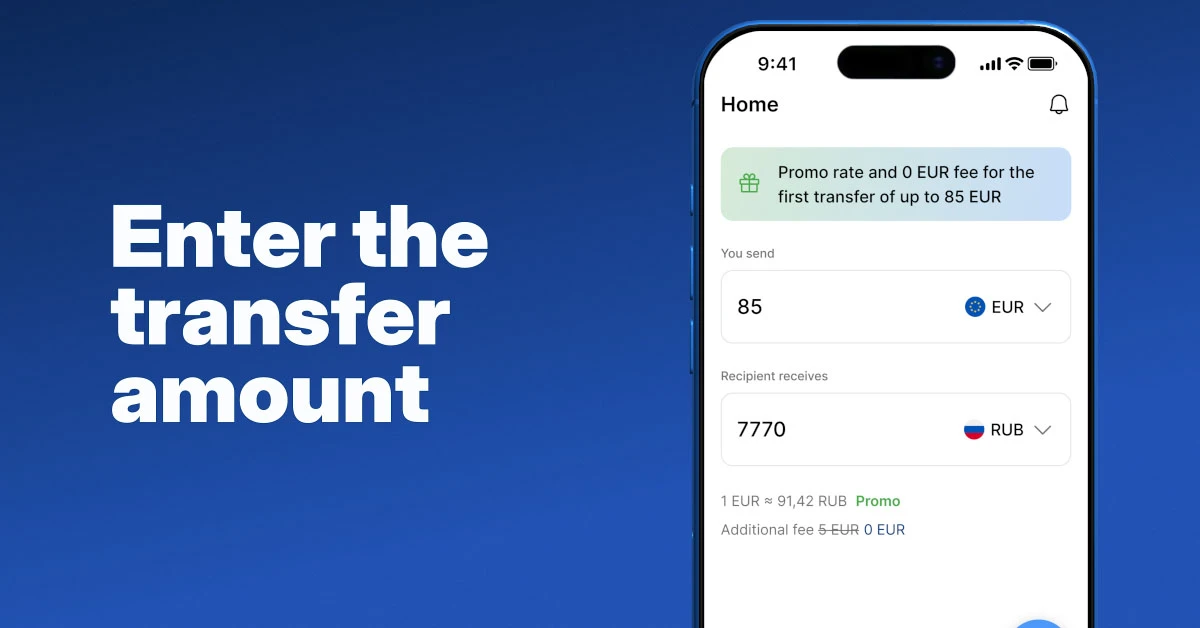
- Add the recipient. For a card payout, the usual details are the recipient’s name, phone number and Russian card number.
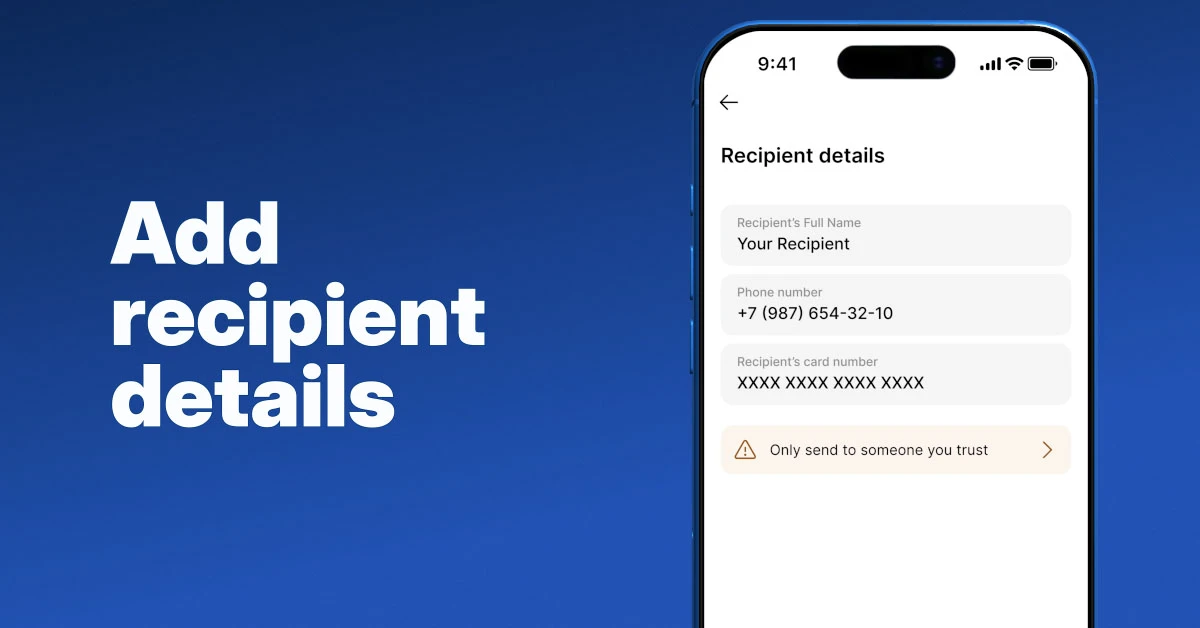
- Choose how to pay. Depending on the transaction and payment partner, available European payment methods may include Visa, Mastercard, Apple Pay, Google Pay, bank transfer, SEPA or Open Banking.
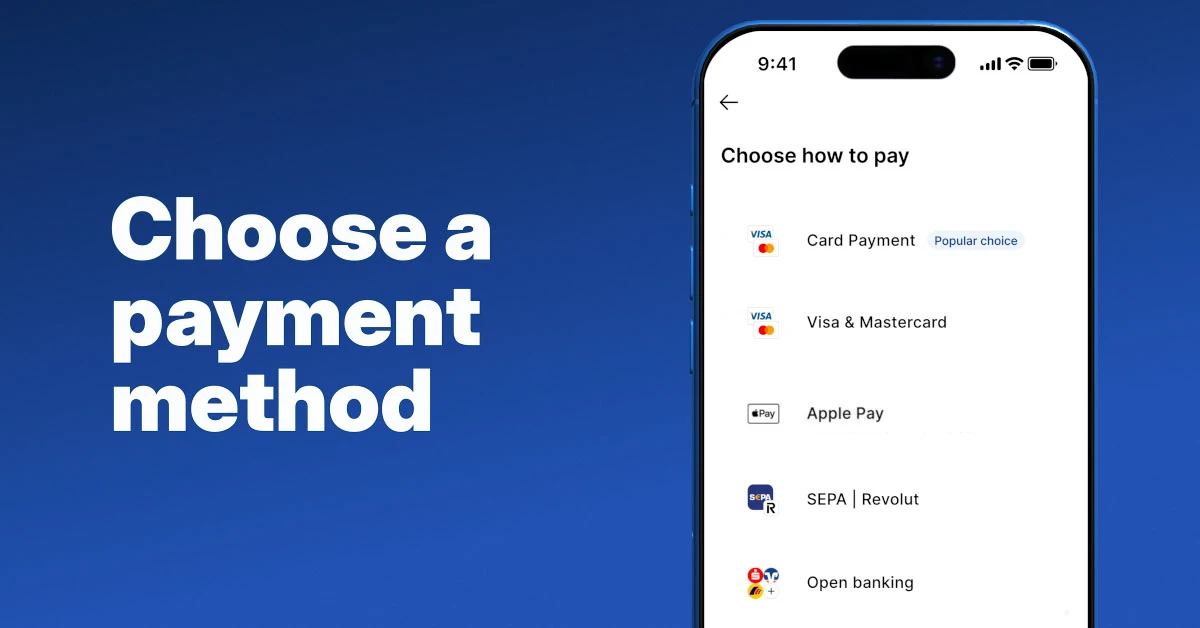
- Confirm and track the transfer. Follow the payment instructions and monitor the transaction from your SendNOW account.
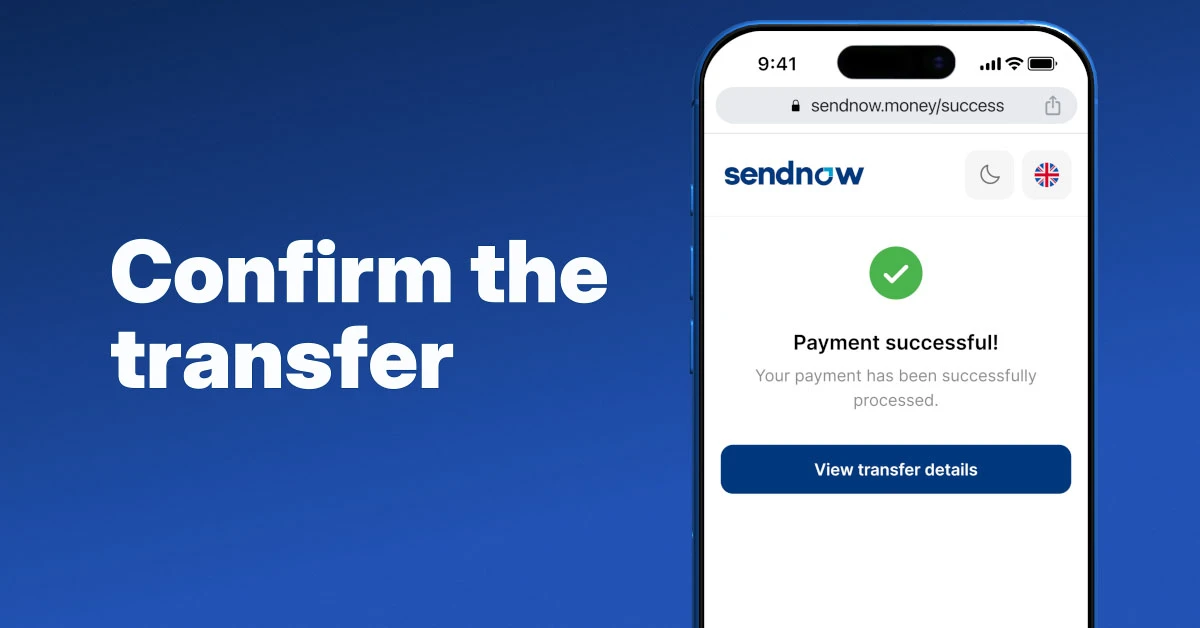
New customers receive a promotional exchange rate and a 0% SendNOW service fee on their first transfer of up to USD 100 or the equivalent. Transfers of USD 200 or more also carry a 0% SendNOW service fee. For transfers of USD 2,500 or more, an improved rate is applied automatically. The standard single-transfer limit is USD 50,000 or the equivalent.
That leads to a practical question: how can you send money to Russia without having to manage several financial services yourself? With SendNOW, the entire process stays within one service.
Costs, exchange rates and speed
A useful way to compare money transfers is to start with what the recipient actually receives. Banks may charge outgoing and correspondent-bank fees Сrypto can involve exchange costs, network fees and a P2P spread.
With SendNOW, the amount to be received in roubles is calculated before payment. That makes it easier to compare a Germany-to-Russia transfer using the same starting amount in EUR.
If you are working out how to transfer money to Russia, compare the payout, transfer fees, speed and support rather than relying on a headline fee alone.
The same applies if you are asking how to send money to Russia now at short notice: transfer processing time matters only if the recipient can actually access the funds when needed.
Germany’s €50,000 reporting rule
Germany has a specific reporting requirement for some larger cross-border payments. The Deutsche Bundesbank states that, since 1 January 2025, certain payments of more than €50,000 between a German resident and a non-resident must be reported under foreign-trade rules. Transfers between your own accounts are exempt. Deutsche Bundesbank
The rule is about reporting; it is not a tax and does not prohibit a payment above €50,000. For larger international transactions, keep evidence of the source and purpose of the funds.
The legal question
A related question is: can you send money to Russia legally from Germany? More precisely: is it legal to send money to Russia in your particular case?
There is no blanket answer for every recipient and transaction. EU sanctions target specified banks, entities, individuals and types of activity. A private family payment may be lawful while a particular banking route is unavailable because one institution in the chain is sanctioned or because a bank’s internal policy is stricter. Council of the EU
If the payment is unusually large, business-related or involves a sanctioned party, specialist legal or compliance advice may be sensible.
Three checks before you send
For a secure money transfer, anyone deciding how to send money from Germany to Russia should make three checks:
- Confirm the recipient’s details and, for SWIFT, the recipient’s bank details before sending.
- Compare the rouble amount the recipient is expected to receive, not just the quoted fee or exchange rate.
- Keep source-of-funds documents for larger transfers and allow for possible manual review.
Another practical question is: can I send money to Russia now? The answer depends on whether the chosen route is available for that particular bank, recipient and payment method.
Conclusion
Germany benefits from highly integrated European payment infrastructure, but Russian transfers sit outside that familiar framework.
International banking services work only on selected routes; crypto and overseas transfers add extra conversion, compliance or tax considerations.
For everyday family support, SendNOW offers a more direct route: EUR on the sending side, payout to the recipient’s Russian bank card and transfer tracking in the same service.
For anyone still weighing up how to transfer money to Russia, the practical difference is how much of the process the customer has to organise themselves.
If your question is how to send money to Russia, choose a service designed for this corridor rather than trying to adapt ordinary European payment tools to a payment route they were not built to support.
One final question remains: can I send money to Russia now? In practice, yes — provided the method, recipient and institutions involved are permitted and supported.
Sources
- Bundeszentrale für politische Bildung — post-Soviet migration in Germany. Background on the roughly three million people with a post-Soviet migration background identified in earlier German census data. bpb — Postsowjetische Migranten
- Council of the European Union — EU sanctions against Russia. Current overview of transaction bans affecting Russian banks. Council of the EU — sanctions explained
- Council of the European Union — 21st sanctions package. July 2026 measures extending the transaction ban to 33 additional Russian credit and financial institutions. Council of the EU — 21st package
- FATF — Russian Federation and current black/grey lists. Russia’s membership remains suspended, but Russia is not listed among FATF’s June 2026 black- or grey-list jurisdictions. FATF — Russian Federation
- Deutsche Bank — SEPA countries. Current list of countries participating in SEPA. Deutsche Bank — SEPA countries
- N26 — Sanctions Policy Statement. Explanation of the bank’s sanctions and financial-crime controls. N26 — Policy Statements
- Sparkasse — international transfers. Guidance on payments outside SEPA, required recipient details, timing and possible charges. Sparkasse — Auslandsüberweisung
- German Federal Ministry of Finance — crypto-assets. Tax guidance covering disposals and exchanges of crypto-assets. BMF — crypto-assets tax treatment
- Deutsche Bundesbank — reporting by private individuals. AWV reporting rules for certain cross-border payments above €50,000 since 1 January 2025. Bundesbank — cross-border payment reporting
- Apple App Store Germany — SendNOW. Germany support, currencies, 190+ destinations, transfer speed and current German storefront information. SendNOW — App Store Germany


